
Car price tracker
Track car prices and stay informed on market trends with our comprehensive car pricing tool. See historical prices and compare models to make an informed decision on your next vehicle purchase. Find the best deal on your dream car today!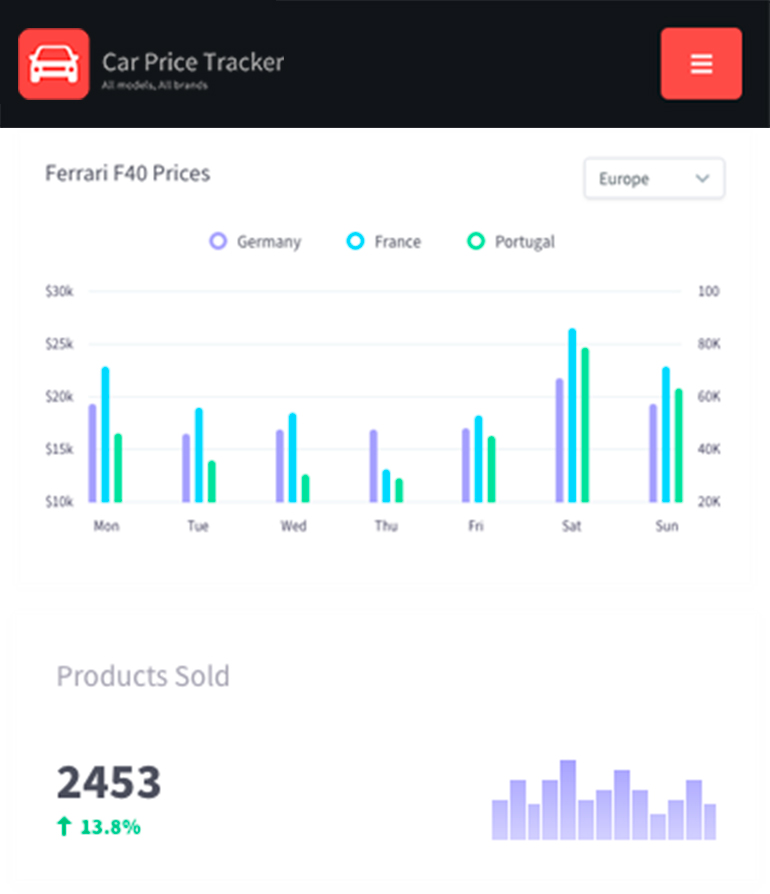
Tesla - Price history
Tesla is positioned at the intersection of luxury and performance, delivering electrified vehicles that set new benchmarks for speed, technology, and sustainability.
Founded in 2003 by Elon Musk and a group of visionaries, Tesla quickly earned a reputation for disruptive innovation—pioneering the mass‑market electric sedan and redefining what a car could look and feel like.
- Model S – the flagship sedan that introduced long‑range capabilities and advanced autopilot features.
- Model 3 – the affordable flagship that expanded Tesla’s reach worldwide.
- Model X – a high‑performance SUV with falcon‑wing doors and unmatched cargo space.
- Model Y – a versatile crossover that blends practicality with cutting‑edge tech.
- Cybertruck – the bold, all‑metal pickup targeting utility and off‑road performance.
- Roadster (future) – aimed at extreme performance and record‑breaking speed.
When evaluating Tesla price or used Tesla price, buyers should consider that Teslas exhibit a depreciation curve that is typically less aggressive than that of internal‑combustion counterparts. While the brand’s premium positioning does command a higher upfront cost, the vehicle’s energy efficiency, lower maintenance needs, and rapid software updates translate into a stronger residual value over time. Studies indicate that Tesla depreciation averages around 30–35 % over three years, significantly below the industry average of 40–45 % for comparable luxury marques.
Market demand remains robust across North America, Europe, and China. Tesla market value is buoyed by a growing base of environmentally conscious consumers, expanding charging infrastructure, and favorable regulatory frameworks. In regions such as Germany and the United Kingdom, the brand enjoys a high resale turnover, with certain models like the Model 3 and Model Y frequently selling faster than their new‑car inventory. In the United States, demand spikes during federal incentive rollouts, while in Asia, the Cybertruck’s launch has sparked renewed interest in the pickup segment.
Resale values are also influenced by model-specific factors. The Model S, with its high initial price but superior interior features, tends to retain value better than the Model 3, which has a larger market of used vehicles. Conversely, the Model X and Model Y, with their spacious interiors and dual‑motor all‑wheel‑drive, maintain strong desirability for families and delivery fleets.
Factors that shape Tesla car prices include:
- Battery cost and technology – as battery pack efficiency improves, the cost of raw materials and manufacturing complexity decreases, directly affecting pricing decisions.
- Supply chain dynamics – semiconductor shortages, component logistics, and factory expansion timelines can cause short‑term price adjustments.
- Government incentives and tax credits – these vary by country, state, or municipality and can reduce the net purchase price for both new and used vehicles.
- Software and feature bundling – over‑the‑air updates, Full Self‑Driving (FSD) packages, and premium infotainment add value without significant hardware changes.
- Regional infrastructure – the density of Supercharger networks and service centers can affect perceived convenience and willingness to pay.
- Competitive landscape – the entrance of new electric players and the price adjustments of legacy automakers influence Tesla’s pricing strategy.
In the used‑car market, used Tesla price reflects a combination of the vehicle’s mileage, battery health, warranty status, and the popularity of its software suite. Since Tesla’s battery degradation is minimal—often under 5 % after five years—many used models remain near original value, further dampening the typical depreciation spiral.
Overall, Tesla’s blend of cutting‑edge technology, brand allure, and resilient resale performance keeps its Tesla market value on an upward trajectory. Whether evaluating current market prices or assessing long‑term ownership cost, consumers can expect that the brand’s emphasis on innovation and sustainability will continue to support robust demand and healthy vehicle valuations across the globe.
Select your model
2010
2012
2013
2015
2019
2020