
Car price tracker
Track car prices and stay informed on market trends with our comprehensive car pricing tool. See historical prices and compare models to make an informed decision on your next vehicle purchase. Find the best deal on your dream car today!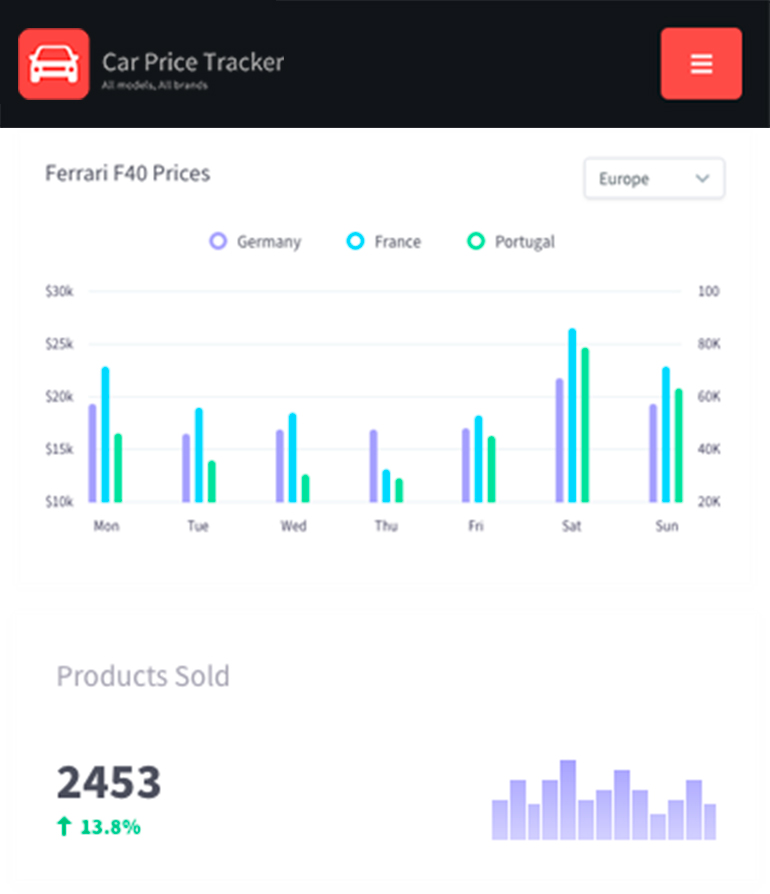
Saab - Price history
Saab – A Legacy of Performance, Safety, and Design
Saab, a Swedish automotive powerhouse, carved its niche as a luxury‑performance brand that prioritized safety, fuel efficiency, and distinctive styling. Renowned for its pioneering use of crash‑worthy chassis construction and advanced materials, Saab positioned itself between mainstream economy cars and high‑end luxury vehicles, offering drivers a blend of sportiness, practicality, and understated Scandinavian elegance.
Brand History and ReputationEstablished in 1945, Saab evolved from a small aircraft manufacturer into a celebrated automobile producer. Over the decades, it built a reputation for rigorous safety testing, turbocharged performance, and eco‑friendly engineering. While the brand faced challenges after Volvo’s acquisition and its eventual shuttering in 2013, the Saabures through enthusiast communities and the continued demand for its iconic models.
Flagship and Popular Models Still In the Market- Saab 9‑3 – a front‑wheel‑drive hatchback/limousine that combined sporty handling with refined comfort
- Saab 9‑5 – a mid‑size sedan known for its turbocharged engines and practical interior
- Saab 9‑7X – a compact all‑wheel‑drive SUV that offered off‑road capability in a sleek silhouette
- Saab 9‑4X – a sport‑utility crossover that merged the Saab try‑ability with a more aggressive stance
- Saab 9‑2X – a niche model aimed at the American market, featuring unique styling and powerful turbocharged drives
While Saab vehicles tended to depreciate more rapidly than mainstream competitors—primarily due to brand uncertainty following its closure—experienced buyers often find that the initial loss stabilizes after the first few years. Saab depreciation for early adopters typically follows a steep drop in the first 18–24 months, after which the rate slows, making them attractive long‑term options for purchase and resale.
Market Demand and Resale Value TrendsCurrent Saab market value clocked at a lower end compared to other premium brands stems from limited new‑vehicle production. However, the residual value of premium trims—especially the turbocharged models with higher mileage—has shown resilience. Enthusiasts and collectors spot premium models in auctions, often driving prices a few percentage points above the average market level. In the US, demand is moderate, while in the UK and parts of Scandinavia it remains strong due to regional affinity for Swedish engineering.
Regional Popularity- Sweden & Norway – Saab’s birthplace preserves a loyal fan base and consistent market presence.
- United Kingdom – A robust resale market exists, supported by a dedicated community and frequent import specialist dealerships.
- United States – Though supply is limited, classic models hold steady demand among niche buyers seeking the brand’s unique storytelling.
- Condition & Mileage – Naturally, vehicles in near‑factory condition or with very low mileage command higher Saab price values. Clean service records further reinforce this trend.
- Trim & Engine Package – Turbocharged engines, twin‑spark technology, or higher trim levels (such as the 0.90 or 2.4 XT options) tend to raise the price curve.
- Limited‑edition models (e.g., the 9‑3 2.0 Sport) keep demand high, thus elevating the Saab car prices relative to standard variants.
- Ownled & used inquiries: Historic aquisitions such as the Saab JAS 39 Gripen ubiquity or the Saab 90 acquired from the Republic of Iceland (historically scarce) have positively impacted the used Saab price for older models.
Select your model
1968
1969
1977
1990
1991
1992
1993
1994
1995
1996
1998
1999
2001
2002
2003
2004
2009
2010
2012