
Car price tracker
Track car prices and stay informed on market trends with our comprehensive car pricing tool. See historical prices and compare models to make an informed decision on your next vehicle purchase. Find the best deal on your dream car today!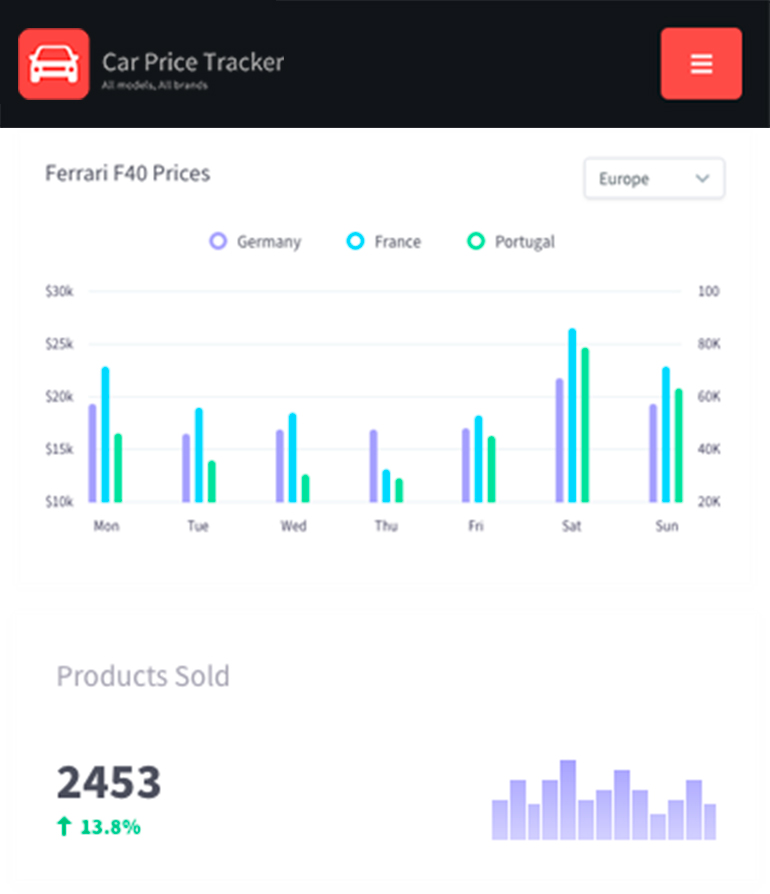
Abarth - Price history
Abarth is a niche Italian brand that positions itself in the high‑performance segment, rather than as a mainstream luxury automaker. Focused on spirited driving and pop‑culture appeal, Abarth delivers compact cars that are driven more for fun than for comfort.
Founded in 1949 by Carlo Abarth, the company originally prospered building high‑speed racing cars and turbocharged commercial models. For decades it earned a reputation for keen engineering, lightweight construction, and a racing pedigree that translates into roadsquared performance. While the startup was absorbed into the Fiat Group in the 1960s, the Abarth name survived as a distinct brand that continues to produce limited‑edition sports cars and turbo‑charged hatchbacks.
Key Models Available Today
- Abarth 695 – a turbocharged 1.3‑liter hatchback, the flagship for everyday coupe enthusiasts.
- Abarth 595 – a hot‑hatch with high‑output 1.4‑liter turbo, known for lively handling.
- Abarth 595 Rally – a rally‑inspired version with enhanced power and gearing.
- Abarth 400 – a compact crossover with a sporty stance.
- Abarth 500x – an SUV‑like crossover that carries the brand’s turbocharged flair.
- Limited‑edition Abarth 595 “Running Man” – only a few thousand units worldwide.
Whether you are buying a brand‑new model or a pre‑owned vehicle, the Abarth price profile is shaped by the brand’s small‑batch strategy and the premium that comes with a racing heritage. As a result, Abarth cars are offered at a price range that is higher than typical economy cars but lower than global luxury sports brands. The used Abarth price tends to remain relatively high due to the brand’s desirability among enthusiasts.
Depreciation and Market Value Insights
In the broader automotive landscape, Abarth depreciation is generally moderate. Because Abarth models are produced in limited volumes and attract a niche segment, the initial drop in value is not as steep as that seen in mainstream sedans. However, the small production numbers also mean aftermarket parts can be scarce, which can affect long‑term resale value.
Typical Abarth depreciation over five years usually falls between 40‑50 % of the original out‑of‑the‑box price—a figure that sits comfortably within the performance car sector. Drivers who keep the car in excellent condition and maintain all service records often see a better Abarth market value after owning the vehicle for several years.
Demand, Resale Trends, and Regional Popularity
- Europe – In Italy, Germany, and the UK, Abarth cars are consistently sought after by motorists who value driving dynamics over luxury.
- North America – While the model lineup is smaller, the U.S. market shows a rising interest, especially in the 595 and 595 Rally.
- Emerging markets such as Brazil and India have begun to adopt certain Abarth models, primarily the 595, due to its affordability relative to sport cars.
Resale value reflects this demand: Abarth models that have higher horsepower, sport-tuned suspensions, or limited‑edition badges command a premium. Conversely, standard models may experience a slightly faster drop in market value because buyers often prefer models that showcase the brand’s racing heritage.
Factors That Affect Abarth Vehicle Prices
- • Model variance – The turbo’s displacement (1.3L vs 1.4L) and power curves directly influence Abarth car prices.
- • Edition or exclusivity – Limited editions such as the Running Man or the Rally variants have a higher asking price due to scarcity.
- • Engine tuning – Optional performance packages (turbo boost, higher compression) raise the cost.
- • Branded accessories – OEM black or carbon trim, upgraded sound systems, and bespoke wheels increase the price point.
- • Market demand – In regions where Abarth cars are rare, import duties or dealer markups can inflate costs.
- • Used vehicle market – When you shop for a used Abarth price, you must consider mileage, wear, and maintenance history.
- • Depreciation curve – Faster depreciation applied by finance companies can increase financed monthly payments.
Understanding these variables gives buyers and collectors a realistic view of what to expect when purchasing a new or used Abarth. Whether you’re looking at a pristine 2019 595 or a pre‑owned 2017 695, the key lies in balancing performance credentials with practical long‑term value. The brand’s emphasis on spirited driving, combined with its limited production approach, keeps both early buyers and long‑term owners engaged, ensuring that the Abarth price stays distinctive yet justifiable within the high‑performance automotive niche.
Select your model
2008
2014
2022