
Car price tracker
Track car prices and stay informed on market trends with our comprehensive car pricing tool. See historical prices and compare models to make an informed decision on your next vehicle purchase. Find the best deal on your dream car today!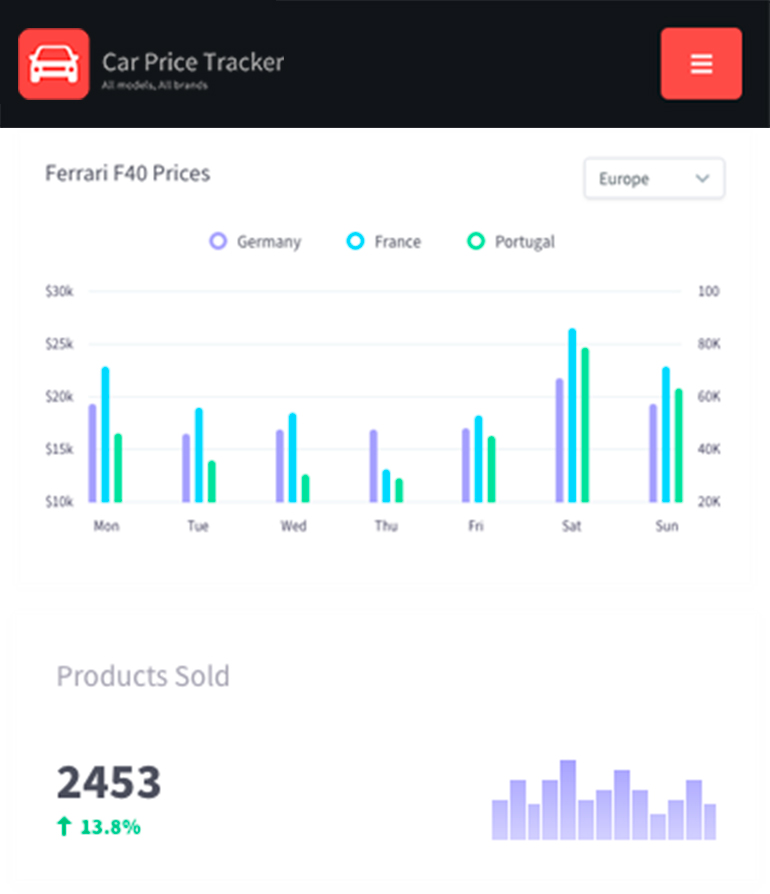
Hyundai - Price history
Hyundai Motor Company is positioned as a mainstream premium brand that blends affordability with modern design, efficient powertrains, and advanced safety technology. It occupies the economy and high‑value segments rather than luxury or pure performance niches.
Founded in 1967 in Seoul, South Korea, Hyundai grew from a steel and construction business to a global automotive leader. Its reputation for value‑centric engineering, generous warranties, and rapid innovation helped the brand climb the industrial ladder and now enjoys widespread consumer confidence worldwide.
- Elantra – Compact sedan with a focus on fuel efficiency and safety
- Sonata – Mid‑size sedan offering a spacious interior and advanced driver helps
- Tucson – Popular compact SUV known for its versatility
- Santa Fe – Mid‑size crossover with a mature design language
- Kona – Subcompact SUV emphasizing high ground clearance
- Ioniq – Clean‑energy lineup featuring hybrid, plug‑in hybrid, and all‑electric models
- Veloster and Accent – Hot‑hatch and entry‑level sedan offerings for specific markets
The brand’s Hyundai price strategy has evolved from simple affordability to a broader value proposition. Across markets, comparably priced rivals still find it challenging to match the integrated features and warranty packages that come standard with new Hyundai releases.
When buyers consider a new or pre‑owned vehicle, Hyundai car prices are typically evaluated on a per‑mile basis, with suppliers factoring in economies of scale from the company’s extensive global production network. Hyundai depreciation typically follows a common pattern among mid‑size family cars: around 40–45 % of the purchase price in the first three years, and close to 60 % after five years. Compared to premium competitors, Hyundai tends to hold a modest share of its original value, partly because the industry benchmark for depreciation is around 50 % after five years for cars in similar segments.
Studying the aftermarket, the current used Hyundai price for a 2021 sedan is often just less than 30 % below the initial new‑car value when the vehicle has average mileage and good maintenance records. The brand’s reputation for durability and cheap parts maintenance keeps used vehicle queries high. In most regions, a well‑maintained 2022 Ioniq‑5 can command a resale that is 2–3% above the original retail price after one year, reflecting strong buyer enthusiasm for electric technology.
Resale value trends for Hyundai demonstrate a steady demand curve. In the United Kingdom, the 2023 Tucson sold for 1.8 % higher than its list price the following year, illustrating a robust secondary market. In Australia, consumer interest in the Kona and Santa Fe has translated into listing periods of less than three months on platforms such as AutoTrader. This market dynamism results from a mixture of escalating fuel costs, environmental incentives for lower emissions vehicles, and an expanding dealership ecosystem that supports after‑sales service.
Regional popularity further influences market value. In the United States, Hyundai's sales share rose from 2.4 % in 2015 to over 7 % in 2023, with a notable surge in the Great Lakes and Pacific coast markets where higher gas prices favor the brand’s efficient engines. In continental Europe, the Ioniq lineup has become a top choice in the Netherlands, where policy-driven subsidies for hybrids and electric cars drive purchase incentives. Meanwhile, in Southeast Asia, diesel‑engine models such as the Tucson continue to perform well due to longstanding fuel preferences and a growing OEM service network.
Key factors that affect Hyundai price dynamics include:
- Trim and option level – higher spec vehicles incur a larger markup and subsequently retain more value.
- Engine type – hybrids and electrics generally depreciate slower because of rising demand for low‑emission powertrains.
- Mileage – a vehicle with fewer than 20,000 km shows a measured premium over average resale values.
- Condition and maintenance history – regular service records, clean sheets, and non‑accident status correlate with higher resale valuations.
- Market shocks – changes in trade policy, tariff adjustments, or fuel price spikes can influence short‑term price fluctuations.
- Technological upgrades – contemporary features such as advanced driver‑assistance systems (ADAS) or next‑generation infotainment can raise a used car’s desirability and market value.
From a value perspective, customers who prioritize long‑term ownership find Hyundai’s combination of lower acquisition costs and moderate depreciation attractive. Purchasers seeking a used vehicle can target late‑model 2019/2020 units, which often showcase the latest safety features without the higher price tags associated with newer releases.
In conclusion, Hyundai remains a benchmark for compelling value, robust safety features, and technology‑driven innovation across diverse markets. Whether evaluating fresh retail figures or second‑hand pricing, the consistent trend is a well‑performed balance
Select your model
1995
1998
1999
2013
2016
2019
2020
2021
2022
2023
2026