
Car price tracker
Track car prices and stay informed on market trends with our comprehensive car pricing tool. See historical prices and compare models to make an informed decision on your next vehicle purchase. Find the best deal on your dream car today!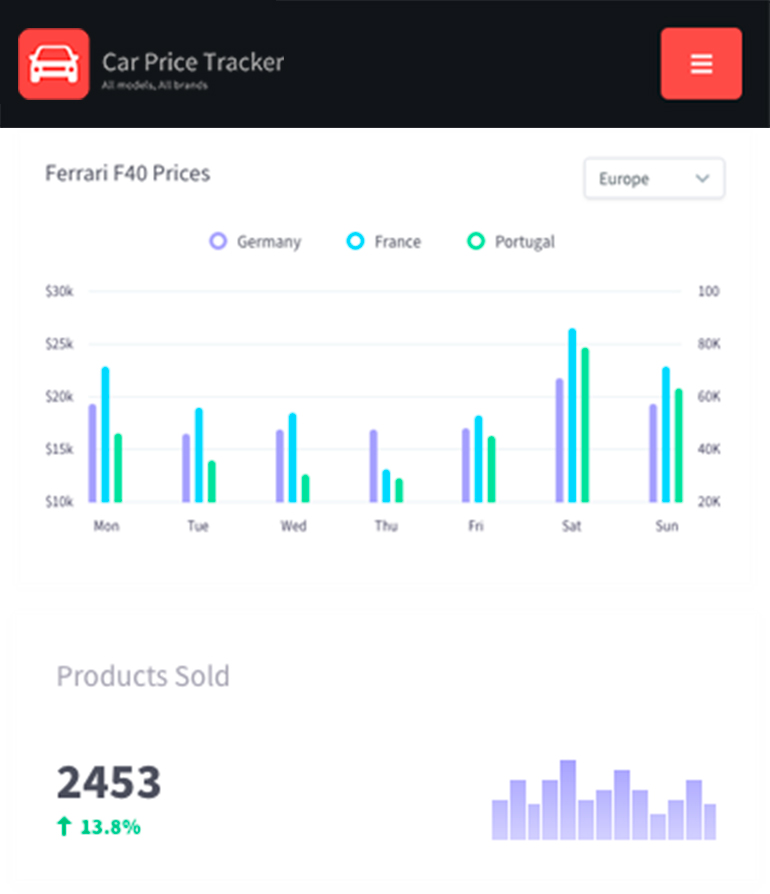
Mazda - Price history
Mazda is positioned in the market as a high‑performance yet affordable brand, blending sport‑oriented dynamics with everyday usability. Known for its “Jinba‑Ittai” philosophy—driving as one with the car—Mazda targets consumers seeking an engaging driving experience without the premium price tag of mainstream luxury competitors.
Founded in 1920, Mazda quickly earned a reputation for engineering excellence, especially in the 1960s and 1970s when it became renowned for lightweight, rear‑wheel drive cars. In recent decades, the brand has revitalized its image with the “Zoom‑Zoom” slogan and a focus on Kinetic Design and Skyactiv technology, reinforcing its credibility as a maker of reliable, fuel‑efficient vehicles that still feel driver‑centric.
- Miata MX‑5 – a lightweight, rear‑wheel‑drive convertible regarded as one of the best road‑trip cars.
- RX‑7 (Shifting to RX‑4 in newer generations) – Mazda’s iconic rotary‑engine sports car, praised for its high revving performance.
- CX‑5 – a compact SUV that balances practicality with a sporty stance.
- CX‑9 – a midsize crossover that offers three rows of seating and advanced driver‑assist features.
- Mazda 3 – a compact sedan/hatch that emphasizes driver engagement and stylish interiors.
- Mazda 6 – a midsize sedan that elevates comfort and technology while maintaining a sporty character.
- MX‑30 – Mazda’s first all‑electric vehicle, demonstrating the brand’s commitment to electrification.
When assessing Mazda price dynamics, buyers should consider that Mazda’s vehicles generally sit below luxury marques yet above many economy brands. This mid‑tier placement means Mazda car prices are competitive, especially when compared to similarly equipped rivals like Honda or Toyota. Buyers often find the used Mazda price to be attractive when the brand’s reputation for durability and low maintenance costs shines through.
On the subject of Mazda depreciation, the brand falls between the high depreciation of luxury cars (e.g., BMW, Audi) and the lower depreciation of cheaper cars (e.g., Datsun, older Volkswagens). According to independent depreciation studies, a new Mazda typically loses about 50‑55 % of its value after five years. However, recent model updates and the introduction of the Skyactiv‑S engine have modestly improved the brand’s long‑term value retention. In contrast, high‑performance models such as the MX‑5 tend to retain better resale value due to their cult status and limited production.
Resale trends reveal that Mazda market value has rebounded in the last three years, partly because the brand newer models attract buyers who value lighter weight and improved fuel efficiency. The high demand for the CX‑5 and the popular MX‑5 hatchback has contributed to steady demand, making used Mazda models relatively resilient. Market data consistently shows that models equipped with the latest connectivity features (e.g., Bluetooth, Apple CarPlay, adaptive cruise control) command a premium over earlier configurations.
Regional popularity varies significantly. In the United States, the MX‑5 and CX‑5 are especially popular in the Midwest and Northeast, where mild climates and a culture of car enthusiasts exist. In Japan and Southeast Asia, the CX‑3 and Mazda 2 resonate with urban drivers who value compactness and fuel efficiency. In European markets, the Corolla‑sized
Select your model
1971
1997
2000
2021
2023