
Car price tracker
Track car prices and stay informed on market trends with our comprehensive car pricing tool. See historical prices and compare models to make an informed decision on your next vehicle purchase. Find the best deal on your dream car today!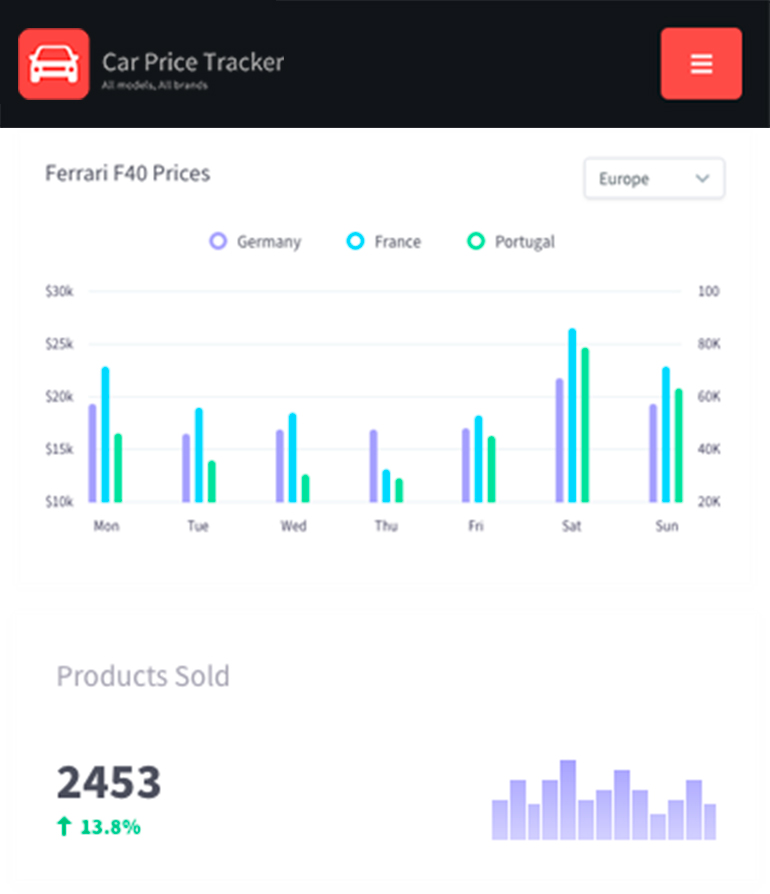
Jaguar - Price history
Jaguar stands as a hallmark of British luxury and high‑performance automotive design. The brand is synonymous with sleek styling, advanced technology, and a legacy of motorsport excellence that appeals to discerning buyers seeking prestige and dynamic driving experience.
Founded in 1922, Jaguar quickly earned a reputation for pioneering engineering and timeless elegance, culminating in iconic models such as the Jaguar E-Type. Today, the marque continues to uphold its heritage while integrating cutting‑edge materials and hybrid powertrains, maintaining a reputation for craftsmanship and performance.
Popular and flagship models available in the market include:
- Jaguar XE – A compact luxury sedan that combines responsive handling with a refined interior.
- Jaguar XF – A midsize executive car known for its spacious cabin, smooth ride, and advanced safety suites.
- Jaguar XJ – The flagship luxury sedan that offers flagship level luxury and extensive customization options.
- Jaguar F-PACE – A premium SUV that blends performance‑grade dynamics with practical versatility.
- Jaguar E-PACE – A smaller crossover that delivers sporty handling and a well‑arranged cabin.
- Jaguar I-PACE – The all‑electric super‑luxury SUV, showcasing the brand’s commitment to sustainable performance.
When evaluating Jaguar price dynamics, buyers should consider several key factors. The marque’s consistent brand prestige, high-quality construction, and the rarity of certain models keep prices elevated compared to other luxury peers. Maintenance costs, including specialist servicing for BM (British Motor) engineered components, exert noticeable pressure on the overall life‑cycle expenditure. Additionally, fuel economy—particularly in diesel‑powered variants—can influence operational costs for long‑term ownership.
Depreciation trends for Jaguar generally reflect the luxury segment’s balance between prestige and cost of ownership. New Jaguar cars typically experience a decline of about 30–35 % in the first year, with a moderate seasonal dip that stabilizes to approximately 10–12 % annually over the next three to five years. Models that benefit from high demand, such as the F-PACE and I-PACE, can depreciate slightly more slowly due to limited production volumes and a growing interest in electric luxury.
The resale market for Jaguar brands is influenced by a combination of demand, model popularity, and technology updates. Limited editions and anniversary variants tend to retain value better, especially when they incorporate unique styling cues or exclusive color palettes. In contrast, models that receive significant refreshes or consolidation in the lineup may experience a steeper reduction in market value.
In terms of Jaguar market value, specific trends vary by region:
- United Kingdom – As the birthplace of Jaguar, the UK remains the brand’s strongest market, reflected in higher demand for both new and used vehicles. Local events and enthusiast communities sustain a vibrant second‑hand market.
- United States – The American market sees a robust enthusiasm for sport SUVs like the F‑PACE, resulting in strong resale frequencies for familiar models. The electric I‑PACE is beginning to carve a niche in states with generous incentives.
- Australia & New Zealand – These markets prize the brand’s blend of luxury and off‑road capability, yielding consistent demand for models such as the E‑Pace and XJ.
- China – Rapidly growing luxury demand makes China a notable region for Jaguar’s global strategy. However, market volatility and regulatory changes impact long‑term vehicle value.
What affects used Jaguar price values? Buyers and sellers alike should watch for:
- Vehicle History – Clean title and low mileage models maintain a higher premium.
- Service Records – Complete documentation of routine maintenance demonstrates the vehicle’s care and can reduce depreciation.
- Technological Features – Newer infotainment upgrades, driver‑assistance systems, and powertrain innovations keep a Jaguar compelling on the secondary market.
- Exterior & Interior Condition – Minor cosmetic wear can quickly erode online listing competitiveness.
When researching Jaguar car prices, prospective buyers should balance several considerations. First, evaluate whether the model offers the desired performance profile—Jaguar’s focus on power and agility means that
Select your model
1935
1937
1938
1949
1950
1956
1975
1978
1980
1981
1982
1983
1986
1987
1997