
Car price tracker
Track car prices and stay informed on market trends with our comprehensive car pricing tool. See historical prices and compare models to make an informed decision on your next vehicle purchase. Find the best deal on your dream car today!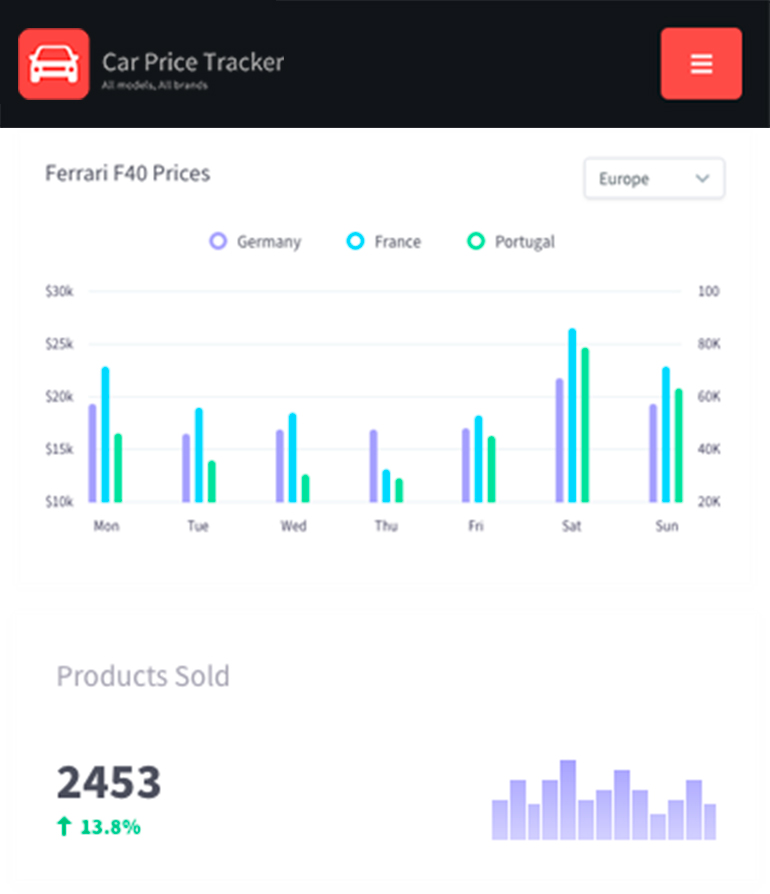
BMW - Price history
BMW has long been positioned at the intersection of luxury, performance, and automotive technology, offering a premium driving experience that appeals to discerning global consumers.
The company traces its roots back to 1916 when the original BMW aircraft and motorcycle manufacturers evolved into the iconic BMW brand we know today. Over the past century, it has earned a reputation for engineering excellence, driving dynamics, and a commitment to innovation—qualities that set it apart from both mainstream luxury rivals and high‑performance specialists.
- 3 Series – A timeless blend of practicality and sportiness.
- 5 Series – The flagship executive sedan packed with technology.
- 7 Series – The pinnacle of luxury and comfort.
- X3 – Compact luxury SUV with off‑road capability.
- X5 – Mid‑size SUV that balances performance and space.
- i3 – Compact electric vehicle focused on efficiency.
- M3/M4 – High‑performance variants for enthusiasts.
When researching BMW price trends, both new and used markets reveal distinct patterns. New BMW models command premium BMW car prices that reflect the brand’s technological investment and brand equity. On the used side, used BMW price estimates vary drastically depending on model, condition, and mileage, but generally hover at a premium relative to comparable competitors due to the brand’s strong resale value.
One of the key factors influencing long‑term BMW depreciation rates is the brand’s robust BMW market value over time. Historically, a BMW retains a higher percentage of its purchase price after three to five years compared to mainstream luxury competitors. This slower depreciation is driven by:
- Engineering durability – Advanced materials and rigorous quality controls reduce wear‑and‑tear.
- Technological innovation – Frequent software updates and electrification options keep models fresh in the eyes of buyers.
- Dealer network – A global dealership footprint and a strong after‑sales ecosystem support ongoing maintenance and parts availability.
- Brand prestige – The cachet of the BMW brand appeals to status‑conscious consumers.
The impact of BMW depreciation is most evident when comparing “new” versus “used” price curves. New BMW cars typically lose about 15–20% of their value in the first year, then 10–12% annually for the next four years. For used BMW models, the loss of value tapers earlier, with a modest 5–8% decrease per year after year three, largely because the standard of the vehicle remains high and maintenance demands align with the brand’s premium approach.
Demand dynamics also play a crucial role in determining BMW market value. In the United States, the BMW 3 Series and 5 Series dominate the consolidated luxury segment, consistently ranking in the top five sellers. In Europe, the X5 leads the SUVs for BMW worldwide, while in China, the compact X1 and the electric i3 have seen explosive growth due to government incentives and a shift toward electrified mobility.
Resale value trends illustrate how BMW holds its market share. According to industry data, used BMW models typically maintain 45–55% of their original price after five years—significantly higher than the 30–40% retention of many competitors. This premium resale price is attributable to a combination of strong BMW depreciation curves and the sustained demand for high‑quality German engineering among second‑hand buyers.
Regional popularity can dramatically affect how a particular model appreciates or
Select your model
1936
1937
1938
1940
1955
1956
1957
1968
1970
1976
1998
2000
2001
2002
2003
2004
2005
2006
2007
2008
2009
2010
2011
2012
2013
2014
2015
2016
2017
2018
2019
2020
2021
2022
2023
2024
2025